
The Agentic SDLC Maturity Model: Where Does Your Organization Stand?
Measuring the maturity of your agentic SDLC offers more than just a baseline. It helps chart a clear path to AI transformation.
Jun 29, 2026 — 10 min read

Adam
Co-founder
We recently hopped off a call with a VP of Engineering who spent the last six months investing in agentic coding tools. Their initial reaction to these tools was par for the course. Excitement, awe, anticipation for what they could automate next. Then came frustration, stalled workflows, and thoughts of “bringing everything back to square one.”
This isn’t a story about one technical leader who bit off more than they could chew. It’s a story about what happens when organizations don’t have a clear process for assessing the maturity of their agentic SDLC and confidently plotting a path forward. As a result, they optimize for the wrong steps, as productivity gains and adoption stagnate.
They’re not alone. Countless organizations are burning themselves out trying to scale agentic tooling beyond isolated wins. Most aren’t expecting to execute like Anthropic. They just need a sensible roadmap to turn scattered experiments into defined workflows, with clear ownership, metrics, and boundaries.
We’re here to provide that roadmap.
Why a Maturity Model?
Most roadmaps assume organizations know where they’re going and what it takes to get there. In our experience, that’s rarely the case with agentic tooling.
Today’s teams are operating in ambiguity. They’re trying to understand where agents actually create leverage, which workflows are stable enough to trust, and how to scale without introducing more complexity than they remove.
A maturity model solves for that ambiguity. It shows where your organization stands, what’s proven at that stage, and what needs to be addressed to advance. With this baseline, technical leaders stop optimizing for the wrong constraint and start charting a practical path toward scaled agentic development.
The Agentic SDLC Maturity Model Explained
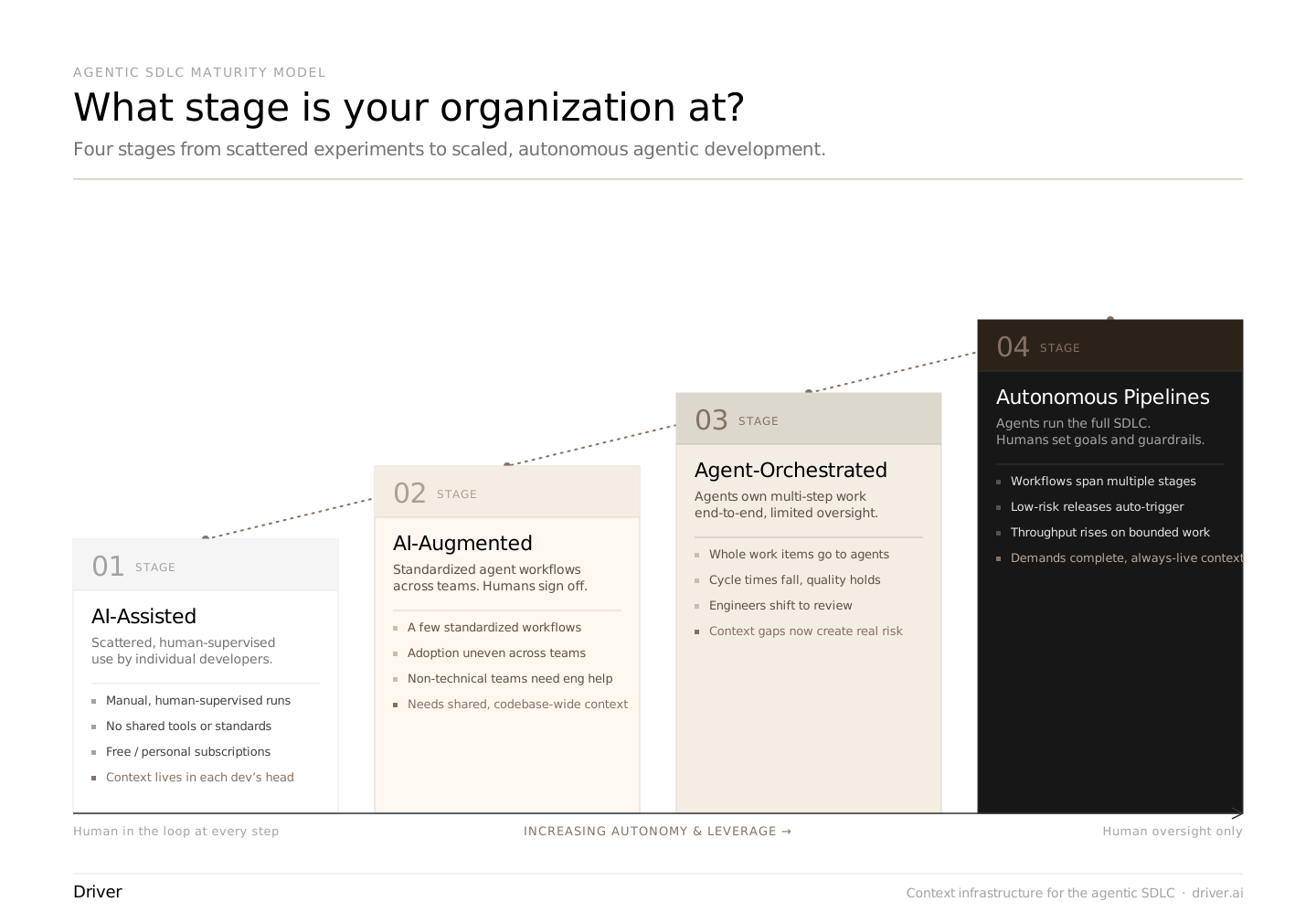
The agentic SDLC maturity model can be broken down into four stages: AI-Assisted, AI-Augmented, Agent-Orchestrated, and Autonomous Pipelines. Progression follows a model with distinct characteristics at each stage.
Stage 1: AI-Assisted
The starting point for every agentic SDLC. At this stage, organizations are seeing scattered use of agentic tools such as Claude Code or Copilot by individual developers, mostly on greenfield projects. For instance, a developer might use Cursor to spin up an API endpoint for a net-new feature while providing context directly at every step.
Despite this being the earliest stage of the agentic SDLC, the efficiency gains appear extraordinary on the surface. Features that would have taken days to create get shipped in hours. The code is clean. The tests pass. And because there’s always a human in the loop, there’s no leap of faith required by leadership.
Keep in mind that AI maturity at this stage isn’t linear; it’s fragmented among power users. Advancing to the next stage means turning individual experimentation into team-level flows, with centralized standards, procurement, governance, and shared expectations for where agents should participate.
Signs your organization is at this stage:
- Every workflow is manually initiated and human-supervised
- No centralized repository of AI tools, workflows, or standards
- Context awareness is limited to individual developers
- Free/personal subscriptions rather than enterprise plans
Stage 2: AI-Augmented
Stage 2 is where experimentation starts converging into an organizational pattern, and where many teams get stuck.
At this point in the maturity model, organizations standardize agentic tooling across workflows such as code review, test generation, and documentation. Teams use agents to generate onboarding guides and explain unfamiliar services during new feature development. Humans still sign off on tasks, but agents play a far more active role in development.
The gains are more substantial than Stage 1 as agents help individual developers move faster while starting to shape the work around implementation. But Stage 2 creates a difficult tradeoff: leadership needs power users to experiment long enough to discover what actually works, then converge before every team settles into its own local system.
Converge too early, and the organization suppresses useful discovery. Wait too long, and teams settle into separate gardens with different tools, prompts, skills, and expectations. One group builds a Claude Code workflow around custom skills. Another uses Cursor with repository-specific rules. A third maintains its own prompts, review gates, and markdown context. Each workflow may work locally, but none of them create a shared organizational capability.
That fragmentation often shows up as sprawling SKILLS.md files, shared skills repositories, and hand-curated markdown. They tend to work well when they focus on procedure: guiding how an agent should research, validate, test, and escalate a task. But, as services move, APIs change, tests shift, dependencies get replaced, and ownership changes, these files start to break down as they don’t reflect the current state of the codebase.
Unless every instruction file is maintained alongside every code change, agents follow the right process against the wrong facts. The result is a parallel maintenance system with the same drift that made internal wikis unreliable. Except now stale context is not just read by humans. It is acted on by agents.
Advancing to Stage 3 requires leadership to use evidence from power users to converge on common patterns without freezing experimentation. Measure which patterns reduce cycle time, rework, prompt iterations, and defects. Promote the proven workflows into governed standards. But ground those workflows in an automatically maintained source of codebase context, not volatile facts duplicated across markdown.
This also matters beyond engineering. Product, support, QA, and other non-engineering teams need controlled access to the right context sources if they are going to use agents without one-off developer help.
One of our customers learned this after onboarding Claude Code and Cursor to support a fast-moving team shipping 120+ commits every single day. Maintaining context manually meant engineers would spend hours redirecting agents rather than shipping code.
After adding Driver’s pre-computed codebase context, they turned context infrastructure from a bottleneck into a throughput engine. Agents receive accurate, dependency-aware context automatically. Engineers understand unfamiliar codebases more quickly. In their words, the team “unlocked the context needed for agentic development to actually work.”
Signs your organization is at this stage:
- Teams have standardized a small set of agentic workflows, but adoption is still uneven across repos or functions
- Non-technical teams still depend on engineering help to get value from agentic tools
- Agent outputs are useful, but can stall when they need codebase context, dependency awareness, or system-level understanding
- Some teams attempt to build their own automated context infrastructure only to find such projects requiring dedicated product effort from their most capable engineers
- Enterprise plans replace personal subscriptions
Stage 3: Agent-Orchestrated
When an organization enters stage 3, agents are no longer just assisting. They’re handling multi-step workflows with meaningful autonomy. They take on bounded work from start to finish, propose improvements, and operate with limited human intervention. Leaders start viewing them less like point tools and more like delegated contributors.
A mature workflow does not start with an engineer writing a ticket and walking away. The engineer uses agents to research the codebase, shapes the plan through several iterations, defines validation tests and constraints, and approves the intended path. Once intent is explicit, implementation can become largely autonomous: the agent creates a branch, writes the code, runs tests, opens a pull request, and responds to review feedback.
The efficiency gains at stage 3 are significant and come from orchestration, not from maximizing hands-off automation. Teams doing well at this stage have clear research, planning, validation, review, and escalation steps. Humans inject architecture, product judgment, and risk awareness upstream so the agent can execute reliably downstream.
Teams also require an equally significant commitment and leap of faith from leadership. The question is no longer, “Will AI write most of my code?” It becomes, “Will AI write so much code that we cannot review it the old way?” Grappling with that reality can be a tough sell, especially for organizations prone to operational inertia.
As QA becomes a much greater focal point to address the influx of code being shipped, organizations spend considerable time establishing quality guardrails, and critical code will often require manual review. Leadership must also do its due diligence to ensure product teams can keep pace with development by building a faster intake process for specs, feedback, and sign-off on agent-generated work.
This stage is where the context chasm hits hardest. When agents handle larger workflows, incomplete context creates larger risks such as missed dependency chains, duplicated functionality, violated conventions, and regressions that traditional review was not designed to catch at agentic speed. Without proper codebase context, feature planning, and quality guardrails, rework cycles can reduce or eliminate productivity gains.
Signs your organization is at this stage:
- Teams use a standardized research-plan-validate-implement workflow
- Humans approve intent, architecture, and exceptions rather than every intermediate action
- Rework, escaped defects, and review load are measured alongside cycle time
- Agents complete bounded work reliably because context and guardrails are built into the process
- The sophistication of the SDLC process matters more than the raw level of automation
Stage 4: Autonomous Pipelines
Today, stage 4 is the industry’s aspirational destination, and almost no organization has reached it at enterprise scale. The challenge is no longer making one agentic workflow effective. It is coordinating many effective workflows running at once.
A mature pipeline might take a validated work item through implementation, testing, release preparation, and low-risk deployment. At scale, however, multiple agents may touch shared services, compete for the same release window, or produce changes with overlapping blast radius. The system must prioritize work, detect dependency collisions, enforce risk policies, and route exceptions before those changes converge in production.
Leaders must define goals, constraints, permissions, review policies, and escalation paths before autonomous pipelines can be trusted. Otherwise, agentic coding tools don’t create leverage. They create uncontrolled change as they move through critical workflows.
Engineers and architects define operating policies, approve architectural direction, set risk tiers, monitor system-wide change, and intervene when an agent crosses a threshold or encounters an exception. They are not absent from the loop. They govern the loop.
Context infrastructure is even more foundational here. Autonomous pipelines cannot function reliably without complete, current context across architecture, dependencies, conventions, history, permissions, and blast radius.
Signs your organization is approaching this stage:
- Agents carry low-risk work from an approved plan through testing and release without manual restarts at each handoff
- Policy-driven controls route high-risk changes, dependency conflicts, and exceptions to humans
- Architects oversee system-wide change and intervene at the plan or exception level
- Context, auditability, rollback criteria, and access controls are built into the pipeline
How Your Organization Can Unlock the Next Stage
Advancing your agentic SDLC’s maturity stage isn’t about buying better tools. It’s about establishing a clear, leadership-driven operating model around the tools you already have.
Here are a few quick tips to get you started on the right path:
Benchmark the Outcomes You Want To Drive
Start with an organization-level business objective, then establish a baseline before expanding automation. Measure current throughput, review time, rework, escaped defects, release quality, support deflection, and the cost of the workflow. Then benchmark agentic workflows against those same measures across teams and repositories.
This prevents a collection of impressive demos from masquerading as return on investment. ShipBob used DX TrueThroughput to evaluate whether its new operating model changed output across the system, not simply whether engineers were using more AI, and recorded a 3x increase across more than 200 engineers.
Assign Dedicated Leadership to AI Transformation
Organizations that successfully advance their maturity stage assign a dedicated leader to spearhead any changes to how the team operates. Without one, adoption becomes a collection of personal habits instead of an organizational capability.
That leader needs to define several things:
- Common workflows: where agents participate, what planning artifact they produce, when humans review, and which tasks remain off-limits
- Success metrics: true throughput, review cycle time, rework, escaped defects, support deflection, or whatever outcome the business needs to move
- Enablement plans: how teams adopt workflows on real work, not abstract demos
- Governance models: which tools are approved, what context agents can access, where approval gates sit, and when work escalates to a human
With a single point of accountability, turning ad hoc usage into organization-wide wins becomes infinitely easier.
ShipBob shows why decisive leadership matters. Jacob Radkiewicz did not leave adoption to individual preference. Every engineer brought a real issue or ticket to an all-team session, received the same workflow and tools, and solved real work with AI. Seeing the workflow in action changed mental models faster than another presentation could.
Choose Infrastructure Over More Tools
As organizations move toward agent-orchestrated workflows, they need architecture, dependencies, conventions, history, and blast-radius context to plan, build, review, and support work safely.
We see this play out the same way everywhere. That context lives scattered across senior engineers’ heads, stale documentation, markdown files, and runtime search results. It works fine for isolated tasks. But the moment you ask agents to handle larger workflows across a fast-changing codebase, incomplete context becomes the core bottleneck.
A context infrastructure layer bridges that gap by giving agents pre-computed, always-current codebase truth inside the tools teams already use. Rather than being scattered, ad-hoc and incomplete, the codebase itself represents the original, statistically complete corpus of context. Driver’s transpiler compiles source code ahead of time into a structured, comprehensive context layer, then exposes that context through a secure MCP server. That context becomes available across planning, implementation, review, QA, support, onboarding, and refactoring.
That is the real inflection point. Agentic coding tools are capable. The question is whether your organization has the roadmap, operating model, and context infrastructure to turn that capability into consistent, scaled results.
If your organization is seeking a beacon to guide you to AI transformation, the answer you’re looking for lies in assessing its maturity stage and crafting a plan of action accordingly.